
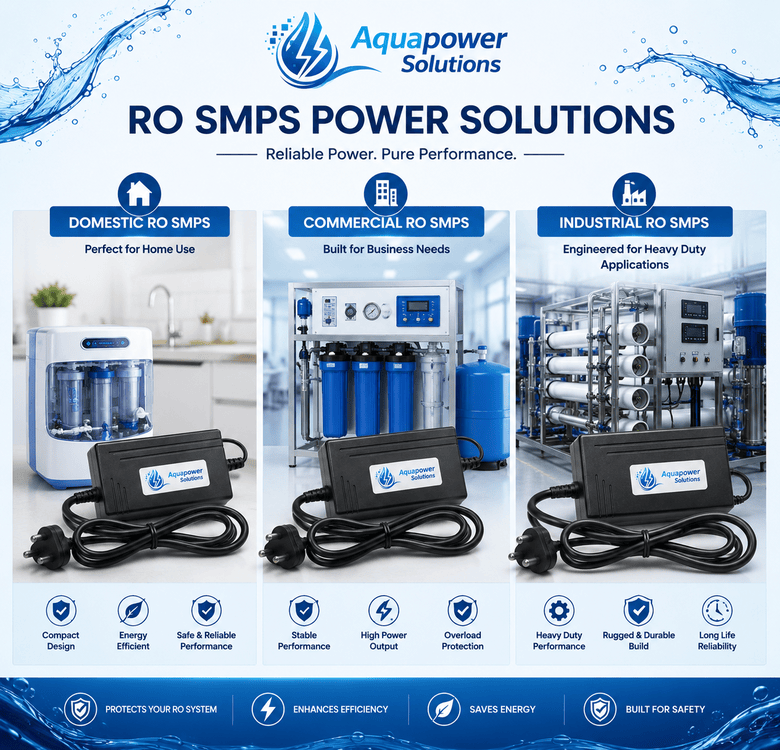
| Quick Summary : a domestic RO SMPS powers a single home purifier, a commercial one handles offices and shops with heavier daily use, and an industrial one is built for plants running almost non-stop. Whichever one you need, it should still handle 110V–270V AC input, run at 85%+ efficiency, and have built-in voltage and short-circuit protection — that part never changes. |
“Best RO SMPS” isn’t really one product — it depends entirely on what you’re powering. A unit that’s perfect under a kitchen sink at home will struggle in a busy office, and something sized for a small shop won’t survive a day in an industrial plant running round the clock.
Let’s break down what actually separates the three, and what stays the same no matter which one you pick.
Why “Best” Depends on What You’re Using It For
An SMPS has one job — take messy, unstable AC power and turn it into clean, steady DC for the RO pump. But how hard that job is changes a lot depending on whether it’s serving one kitchen tap or a plant running around the clock. Undersize it for a heavy-use setting and it’ll fail fast. Oversize it for a small home unit and you’re just paying for capacity nobody needs.
Domestic RO SMPS
This is what sits inside home water purifiers, usually tucked under the kitchen counter, serving one household. It doesn’t need to push a huge output, but it does need to be compact — and honestly, it needs strong voltage protection more than the other two, since home wiring in India tends to see some of the roughest voltage swings.
Priority here: small size, low standby power, and solid protection.
Commercial RO SMPS
Think offices, shops, clinics, small restaurants — anywhere a decent number of people are drawing water through the day. These units need to handle a higher, steadier output than a domestic one because they’re running longer cycles daily.
Priority here: durability under regular daily use, good efficiency (electricity costs add up fast at this scale), and reliable protection given how often it’s switching on and off.
Industrial RO SMPS
This is for manufacturing plants and large facilities running RO systems almost continuously. It needs the highest output of the three, and it has to handle sustained, near-constant operation without overheating.
Priority here: reliability over long duty cycles, good heat management, and a build that can go months without needing attention.
Quick Comparison
| Factor | Domestic | Commercial | Industrial |
| Setting | Home / kitchen | Office, shop, clinic | Manufacturing plant |
| Output need | Low, occasional use | Medium, longer daily cycles | High, near-continuous |
| Priority | Compact size, protection | Durability, efficiency | Long-duty-cycle reliability |
| Voltage range | 110–270V AC | 110–270V AC | 110–270V AC |
| Protection | Over/under-voltage, short circuit | Over/under-voltage, short circuit | Over/under-voltage, short circuit |
What Doesn’t Change, No Matter Which One You Pick
- Wide voltage tolerance (110–270V AC) — Indian power doesn’t care what category your SMPS is
- 85%+ efficiency, for less heat and lower running cost
- Built-in protection as standard, not something you pay extra for
- Every unit tested before it leaves the factory, not just a random sample
How We Cover All Three
At Aqua Power Solutions, we manufacture RO SMPS for domestic, commercial, and industrial systems out of the same facility in Delhi, and we hold every unit to the same baseline — 110–270V AC input, 85%+ efficiency, built-in protection. That means dealers and OEMs stocking a full range don’t need to juggle different suppliers depending on category.
FAQs
What’s the main difference between domestic and commercial RO SMPS?
Output capacity and duty cycle. Commercial units are built to handle higher, more sustained current draw than domestic units designed for occasional home use.
Can an industrial RO SMPS be used for a domestic purifier?
Technically yes, but it’s overkill — a properly rated domestic unit is the more efficient, more cost-effective choice.
Do all three types need the same voltage protection?
Yes. Over-voltage, under-voltage, and short-circuit protection matter across every category, since Indian grid fluctuations affect households, offices, and plants alike.
How do I know which category my system needs?
Match it to your RO pump’s rated output and typical daily run-time — a supplier can help you pick the right capacity once you share those details.
Does Aqua Power Solutions supply all three types?
Yes, we manufacture RO SMPS suitable for domestic, commercial, and industrial RO systems.
| Not sure which one your system needs? Send Aqua Power Solutions your RO pump’s specs and usage pattern, and we’ll help you match it — or browse our SMPS spec sheet at aquapowersolutions.in/smps yourself. |